

Norton adds scam checks to Claude across all tiers
Wed, 1st Jul 2026.webp)
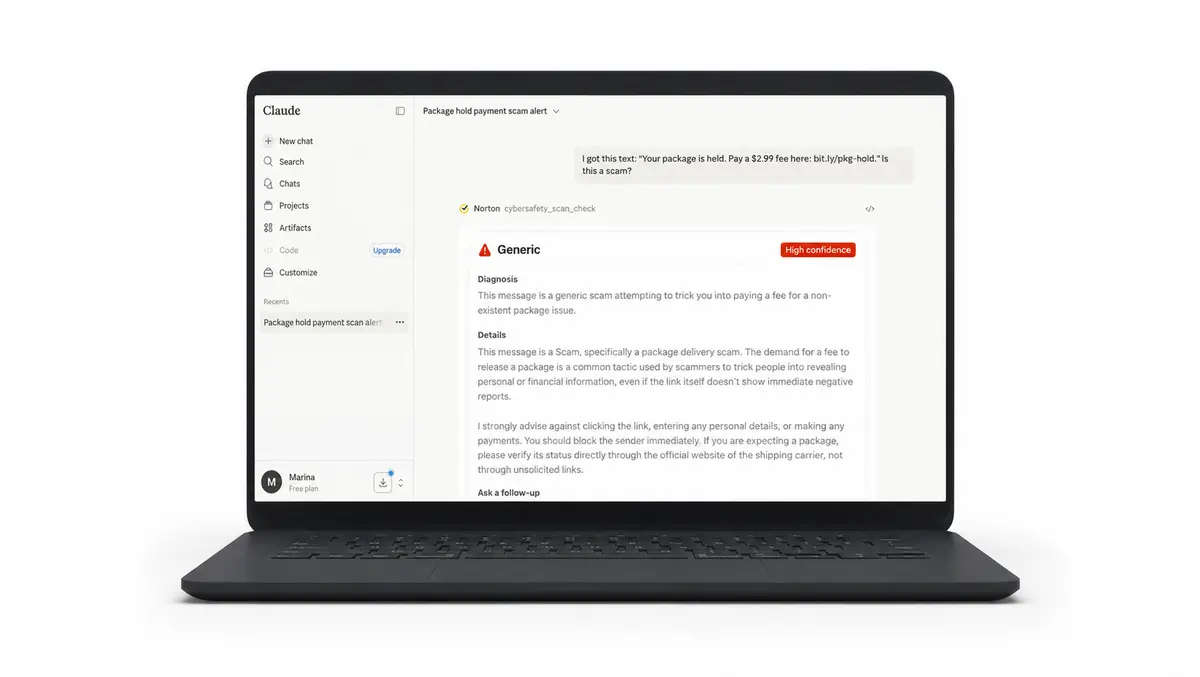
Norton has added its Genie scam detection tool to Anthropic's Claude, making scam checks available across all Claude tiers.
Users can now analyse suspicious emails, text messages, links and images within a Claude conversation by turning on the Norton connector. The tool assesses whether content appears safe, risky or fraudulent and can also provide general cyber safety advice.
The move extends Norton's recent push to place its scam detection technology inside mainstream artificial intelligence assistants. Earlier this year, Norton introduced Genie to ChatGPT, and the Claude launch adds another large consumer AI platform to that effort.
Scam detection has become a growing use case for AI assistants as consumers increasingly ask chatbots to assess whether messages, offers or requests are genuine. The service is designed for common situations such as package delivery texts, account suspension emails, suspicious links and online offers.
How It Works
Within Claude, Norton Genie reviews the broader context of a message rather than isolated keywords. The system examines language patterns, urgency cues, impersonation attempts, requests for sensitive information and other signs of social engineering.
It also analyses URLs and domains by expanding links, inspecting destination sites and evaluating trust and reputation signals. Based on that review, the service tells users whether to avoid replying, not click a link or delete a message.
The integration also reflects a wider shift in how cyber security companies are trying to meet users where online decisions are made. Instead of asking people to switch apps or use separate websites, this model places fraud checks directly inside the conversational tools many people already use to evaluate information.
That approach matters because scams now appear across a broad range of digital settings, from text messages and social platforms to online marketplaces, dating apps and fake customer support exchanges. The rise of AI-generated material has added another layer of difficulty by making fraudulent content more personalised and convincing.
The launch also sits within Norton's broader consumer safety business under parent company Gen.
"AI assistants are becoming part of how people make decisions and evaluate information online," said Travis Witteveen, Head of Products and Portfolios, Gen. "People are already asking AI tools whether something feels legitimate, suspicious, or safe to engage with. By bringing Norton Genie into even more AI platforms like Claude and ChatGPT, we're making trusted Cyber Safety intelligence available directly in those moments to help people make more confident decisions in real time."
Everyday Use
Norton framed the Claude integration around routine consumer questions rather than specialist security tasks. Its examples included checking whether a missed delivery text is legitimate, whether an urgent account warning is real, whether a link looks suspicious and whether an online offer may be a scam.
That everyday positioning is important for AI platforms trying to broaden practical use beyond writing, search and coding. It also gives cyber safety providers a route into daily consumer interactions at a time when phishing and impersonation fraud continue to evolve.
Norton's anti-scam systems already support millions of people across products in the Gen portfolio. By moving Genie into Claude, Norton is widening access to that intelligence without requiring users to leave the assistant interface.
The launch adds to competition among security companies and AI platform providers to build trust features into consumer-facing services. As assistants are used more often to assess messages and links, integrations like this suggest scam screening may become a standard function rather than a separate security step.
In Claude, the service can review suspicious emails, texts, messages, images and links and provide "clear, easy-to-understand guidance directly in Claude, explaining why something may be risky and what steps to take next, such as avoiding a reply, not clicking a link, or deleting the message altogether."