

%201.webp)
Space Forge has completed the National Microgravity Research Centre at Swansea University, concluding a £13 million programme part-funded by the UK Space Agency. The start-up will use the site as a base for terrestrial semiconductor processing alongside its in-orbit manufacturing work.
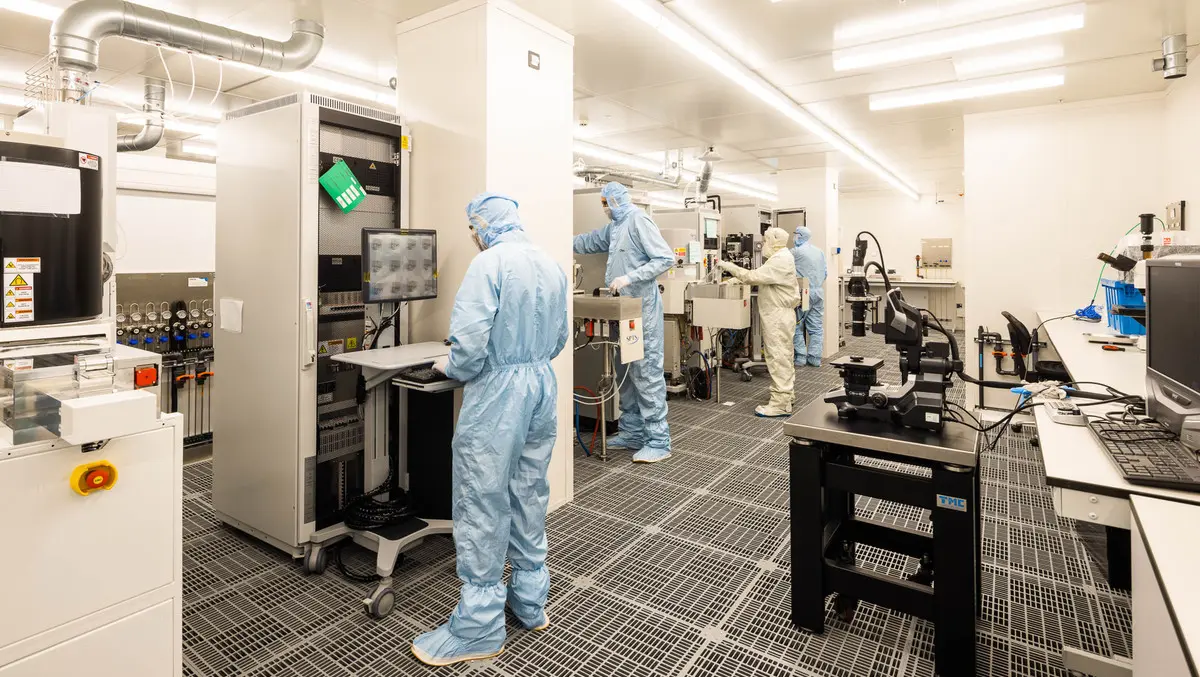
The facility sits within the Centre for Integrative Semiconductor Materials (CISM) at Swansea University. It provides Space Forge with a dedicated cleanroom incubation bay and access to the site's semiconductor processing and characterisation tools.
Hybrid model
Space Forge is developing a hybrid manufacturing model that combines microgravity materials growth in low Earth orbit with follow-on processing on the ground. Its ForgeStar satellites are designed to grow semiconductor seed wafers in microgravity, which are then returned to Earth for scale-up work at Swansea.
The centre is intended to be the terrestrial anchor for this model, linking mission data from orbit with the development of microgravity growth tools and on-the-ground processing methods at the university facility.
The National Microgravity Research Centre also made Space Forge the first incubation client at CISM. The company will work alongside researchers and other organisations based at the site. Funding was provided through the UK Space Agency's Space Clusters Infrastructure Fund.
Orbit progress
The completion of the Swansea facility follows progress on Space Forge's first satellite mission. ForgeStar-1 launched on SpaceX's Transporter-14 mission in June 2025 and later generated plasma in orbit in December 2025.
Space Forge presented the plasma milestone as evidence that the conditions needed for gas-phase crystal growth can be created and controlled on a commercial spacecraft. Mission data is being used to inform future missions and development work at Swansea.
Microgravity materials research has attracted growing interest from governments and industry as the space sector looks for commercial applications beyond communications and Earth observation. Space Forge's approach centres on manufacturing processes it argues are difficult to replicate on Earth because of gravity-driven convection and other environmental factors.
Materials focus
At Swansea, Space Forge is focusing on radiation-hard wide-bandgap materials used in power electronics, including silicon carbide, gallium nitride and gallium oxide. These materials are used in applications where high voltages, high temperatures and power efficiency matter, such as electric vehicles, industrial power supplies and energy infrastructure.
Space Forge says microgravity offers stable thermal conditions, an ultra-high-vacuum environment and the absence of convection during materials growth. It is positioning the work within a broader push for resilience in semiconductor supply chains.
The announcement also cited the projected scale of the global market, with the semiconductor industry forecast to reach US$1 trillion in annual revenues by 2030.
Wales cluster
The Swansea facility is part of a broader compound semiconductor ecosystem in South Wales. CISM sits within the CSconnected cluster, which has attracted £55 million of UK and Welsh Government investment and aims to build regional manufacturing and innovation capacity in compound semiconductors.
Space Forge said its presence at CISM strengthens Wales' position in the UK's sovereign semiconductor supply chain. The company is headquartered in Cardiff and also has operations in Florida.
Semiconductor supply chain sovereignty has become a recurring theme in UK and European industrial policy, reflecting concerns over concentrated manufacturing capacity in Asia and the exposure of high-value sectors to geopolitical shocks. The UK government has signalled interest in building domestic strengths in specific segments, such as compound semiconductors, rather than replicating the full silicon logic manufacturing chain.
"When we secured this funding in 2023, we set out to build something that would advance microgravity materials and open doors for other space companies to do the same. Being based at CISM gives us access to world-class semiconductor infrastructure and a community of researchers and talent that will help us move faster," said Joshua Western, CEO and Co-founder of Space Forge.
The UK Space Agency framed the project as part of its work to develop regional space clusters.
"The completion of the National Microgravity Research Centre is another concrete example of what our Space Clusters Infrastructure Fund is designed to achieve - tangible, lasting infrastructure that strengthens the UK's space economy and builds sovereign capability in strategically important technologies. Space Forge has demonstrated real ambition, from launching the first British-built in-space manufacturing satellite to now establishing a world-class terrestrial facility at Swansea University. This investment is helping to cement Wales and the wider UK as a serious player in the future of semiconductor manufacturing," Dr Paul Bate, CEO of the UK Space Agency, said.
Space Forge said it will use the Swansea centre to develop microgravity growth tools and to support terrestrial scale-up work linked to future ForgeStar missions.