

EUMETSAT puts Meteosat-13 infrared sounder into service
Thu, 22nd Oct 2026 (Today)
EUMETSAT has brought operational data from the Infrared Sounder on its first Meteosat Third Generation sounder satellite into service. The spacecraft has also been renamed Meteosat-13.
This marks the start of routine use of Europe's first geostationary infrared sounder for weather forecasting, giving national weather services atmospheric measurements over Europe every 30 minutes.
The instrument observes temperature, humidity and trace gases through different layers of the atmosphere. Its data are expected to support earlier warnings of severe weather and improve air quality forecasts across EUMETSAT member states.
Meteosat-13 was launched as the first Meteosat Third Generation sounder spacecraft and carries two instruments. The Infrared Sounder is Europe's first of its kind in geostationary orbit and the first in an operational global weather observation programme.
From a position about 36,000 kilometres above the equator, the sounder measures nearly 2,000 infrared wavelengths. Those signals are used to build a picture of atmospheric conditions at different heights and to monitor ozone, dust and volcanic ash.
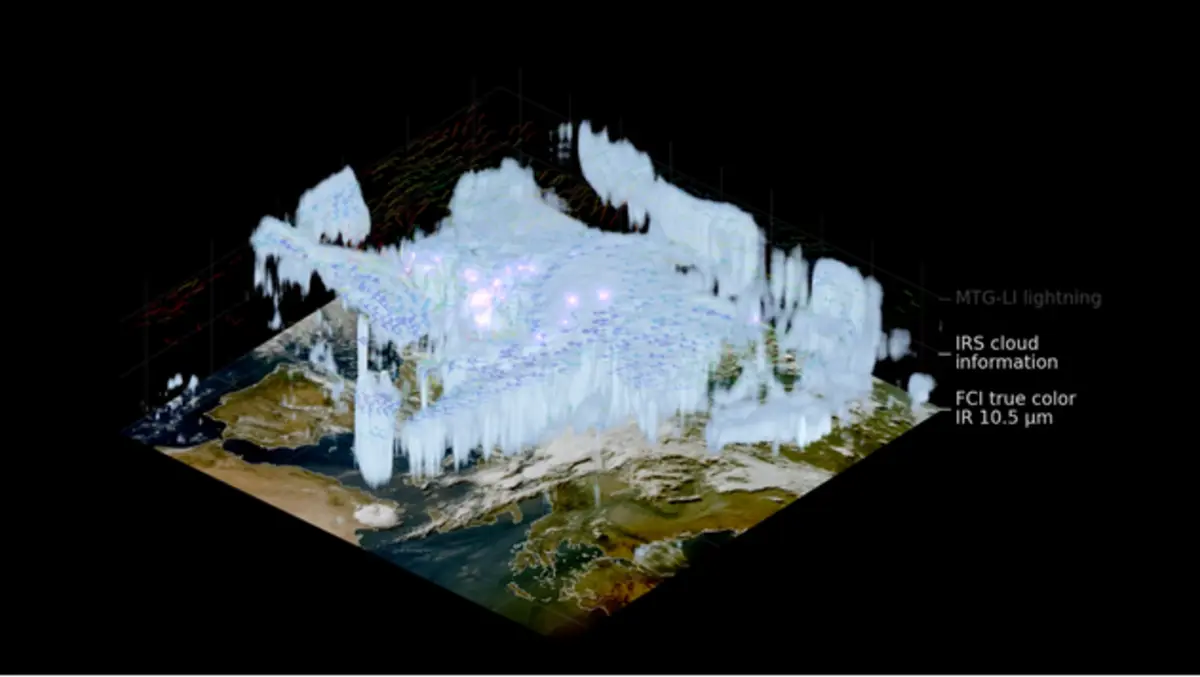
Its data can be combined with observations from Meteosat Third Generation imaging and lightning instruments to show how storm systems develop over time. This gives forecasters a changing view of conditions through the atmosphere rather than a single snapshot.
Phil Evans, Director-General of EUMETSAT, said national forecasters can now identify instability before clouds form.
"National weather services across EUMETSAT member states can now use these data to detect signs of atmospheric instability even before clouds begin to form," Evans said.
He linked the new dataset to the wider Meteosat Third Generation system.
"Together with the imaging and lightning sensors on our MTG imager satellites and their rapid revisiting time, they give a true four-dimensional view of the atmosphere, enabling forecasters to follow a storm over Europe from early instability through its growth to full-intensity lightning and precipitation for the first time," Evans said.
He added: "Climate change is making extreme weather more frequent and intense, and these data will enhance short-range forecasts of flash floods, violent storms, hail and dangerous winds. Forecasters will see weather risks earlier and in more detail, so citizens, first responders and civil authorities can act faster, and that saves lives. My sincere thanks go to our member states and all the teams involved at EUMETSAT and partner organisations that made this achievement possible."
Forecast models
The data will also feed into forecast models used by the European Centre for Medium-Range Weather Forecasts. The centre said the system's value comes from combining imagery with more detailed vertical information about the atmosphere.
"The strength of the MTG system lies in how its two types of satellite, MTG-I and MTG-S, work together," said Tony McNally, Head of Earth System Assimilation at the European Centre for Medium-Range Weather Forecasts.
He said the combination should improve forecasting accuracy and warnings.
"Imagers bring spatial detail to track clouds, lightning and surface events such as wildfires. The sounder adds more three-dimensional information on atmospheric temperature and humidity at different heights. This is a very powerful combination and, when used in our forecast models, allows us to provide more accurate predictions and better warnings of severe weather," McNally said.
Meteosat Third Generation is the latest version of Europe's geostationary weather satellite system and one of the most complex Earth observation programmes developed on the continent for weather and climate monitoring. Meteosat-13 now joins the operational Meteosat-12 imager satellite in the network.
A second imager satellite, known as MTG-I2, is being commissioned and is expected to scan Europe every 2.5 minutes. The broader system was developed with the European Space Agency and built by European industry led by Thales Alenia Space, with OHB responsible for the sounder satellite.
Meteosat-13 also carries a second instrument for the European Union's Copernicus Sentinel-4 air quality mission. That instrument is expected to begin delivering operational data in 2027.
EUMETSAT, which serves 30 member states, operates meteorological satellites from its base in Darmstadt, Germany. Its fleet includes geostationary Meteosat satellites for continuous observation of fast-developing weather systems and polar-orbiting Metop satellites that contribute to longer-range forecasting.