

Finland courts UK partners on resilient sovereign space
Fri, 27th Feb 2026
Finland has convened senior UK defence and aerospace stakeholders in London for talks on Earth observation, resilient satellite navigation and secure space-enabled communications, as European governments reassess dependencies in space and defence technology supply chains.
Hosted at the Finnish Ambassador's Residence, the meeting brought together UK defence institutions and six Finnish companies working in space and security technologies: ICEYE, Kuva Space, Kelluu, Modirum Platforms, ReOrbit and SharpNav.
The agenda focused on Earth observation and positioning, navigation and timing. Discussions also examined resilient space capabilities and how they could support UK operational needs in contested environments, including maritime activity and northern approaches.
Finland's Minister for Foreign Trade and Development, Ville Tavio, opened the event by framing the discussion around European space sovereignty and the need to reduce reliance on external suppliers.
"In the current geopolitical context, Europe must develop its capabilities in order to enhance its capacity to act on its own and reduce dependencies. We must ensure that European space capabilities are developed efficiently. In this field, we see that Finland and the UK would be an excellent match. In both countries, we need growth and prosperity. In addition, we need economic activity and more partnerships with like-minded and trusted countries and companies," said Ville Tavio, Minister for Foreign Trade and Development, Finland.
The event also referenced remarks by the UK Prime Minister at the Munich Security Conference: "There is no British security without Europe, and there is no European security without Britain."
Arctic context
Speakers pointed to Finland's geography and security environment as a driver of domestic technology development. Finland has a 1,300km border with Russia and operates in Arctic conditions, a setting that has sharpened its focus on services that work in poor weather and contested electromagnetic environments.
Those themes are increasingly prominent across Europe as governments place greater emphasis on resilience and assured access to data. Defence planners are also assessing how quickly commercial space services have been integrated into intelligence, surveillance and reconnaissance, as well as mission planning.
Major General (Ret.) Juha-Pekka Keränen, former Commander of the Finnish Air Force, delivered a keynote on how civilian space technologies are shaping modern operations. He focused on operational awareness, data processing and the pace of targeting cycles, and highlighted sovereign access to data and sensor integration as priorities for multi-domain operations.
Company focus
The companies presented capabilities spanning satellite imagery, navigation resilience and communications. Demonstrations included synthetic aperture radar imagery, hyperspectral Earth observation and analytics, and systems designed to maintain positioning and timing when GPS is disrupted.
Exhibits also included software-defined satellite connectivity and secure communications products. The line-up extended beyond satellites to lower-altitude persistent intelligence, surveillance and reconnaissance platforms and mission systems designed for interoperability.
ICEYE showcased synthetic aperture radar satellite imagery, which can collect data through cloud cover and at night. Kuva Space presented hyperspectral Earth observation and analytics, while SharpNav focused on GPS-resilient positioning and timing. ReOrbit and Modirum Platforms addressed satellite communications and connectivity, and Kelluu presented lower-altitude persistent platforms.
The event framed these products and services around operational needs in degraded environments, including the requirement for resilient command and control across maritime, air and joint domains.
Procurement barriers
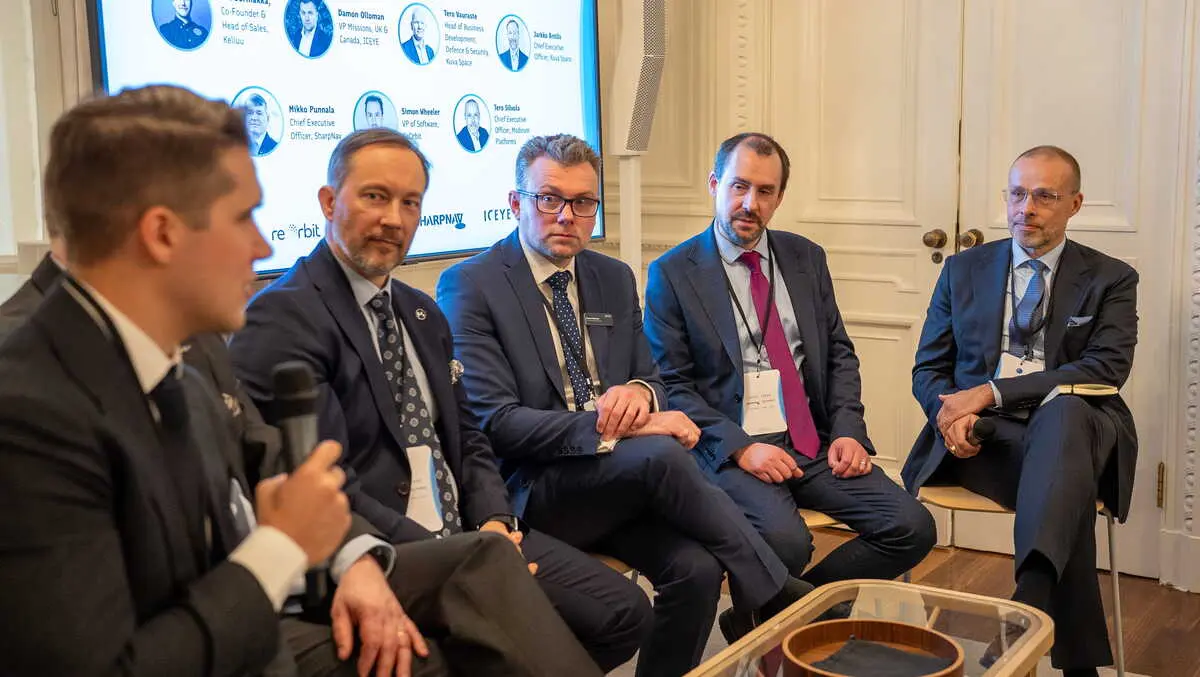
A panel of company representatives discussed practical steps to strengthen UK-Finland industrial cooperation. Topics included procurement barriers, interoperability, and how to move from pilots to operational use more quickly.
Participants stressed the value of operational experimentation and early engagement with end users. The session also encouraged government organisations to use short pilot agreements with start-ups and scale-ups, and urged companies to define clearly the operational problems they address.
Wider relationship
The London dialogue formed part of a broader effort by Helsinki to deepen ties with the UK in defence and advanced technology. Finland has strengthened its defence relationship with the UK following its accession to NATO and the Joint Declaration on Strategic Partnership signed in 2024.
The meeting also aligned with Finland's Team Finland strategy, which identifies the UK as a priority market for digital services and advanced technologies. This reflects the UK's role as a major European defence spender and a long-established space and aerospace market with an active commercial sector.
Ambassador Teemu Turunen called for resilience in technology choices and supply chains. "Every dependency is a vulnerability," he said.
Industry participants said they expect further engagement with UK stakeholders on trials and service testing, as both sides look for practical routes to collaborate on Earth observation, resilient navigation and secure communications.