

SiTime launches new clocks for AI data centre gear
Mon, 23rd Nov 2026 (Today)
SiTime has introduced the FemtoClock 4 and VersaClock 8 clock families for data centre networking and computing systems, targeting a US$2 billion serviceable addressable market over the next five years.
The families are aimed at data centre rack applications built around newer connectivity standards that double bandwidth over previous generations. The launch focuses on systems using 224G serializer-deserializer links for Ethernet switching and PCI Express 7 for interconnects between processors, accelerators, memory, storage and SmartNICs.
The announcement reflects a broader shift in AI infrastructure, where data movement inside servers and switches is becoming a design constraint alongside processor performance. Higher signalling speeds leave less tolerance for timing errors, increasing the importance of components that control clocking and signal stability.
Dell'Oro Group, cited by SiTime, expects 1.6 Tbps ports in AI back-end switches to ramp at least five times faster than 800 Gbps ports across scale-up, scale-out and scale-across networks. That matters for operators trying to keep expensive xPU resources fully utilised.
FemtoClock 4 is positioned for Ethernet networking in top-of-rack and spine switches built on 224G SerDes. It combines jitter attenuation and clock generation, supports up to six frequency domains across 18 outputs, and is intended to reduce the number of devices required in switch designs that typically need more than 40 clocks.
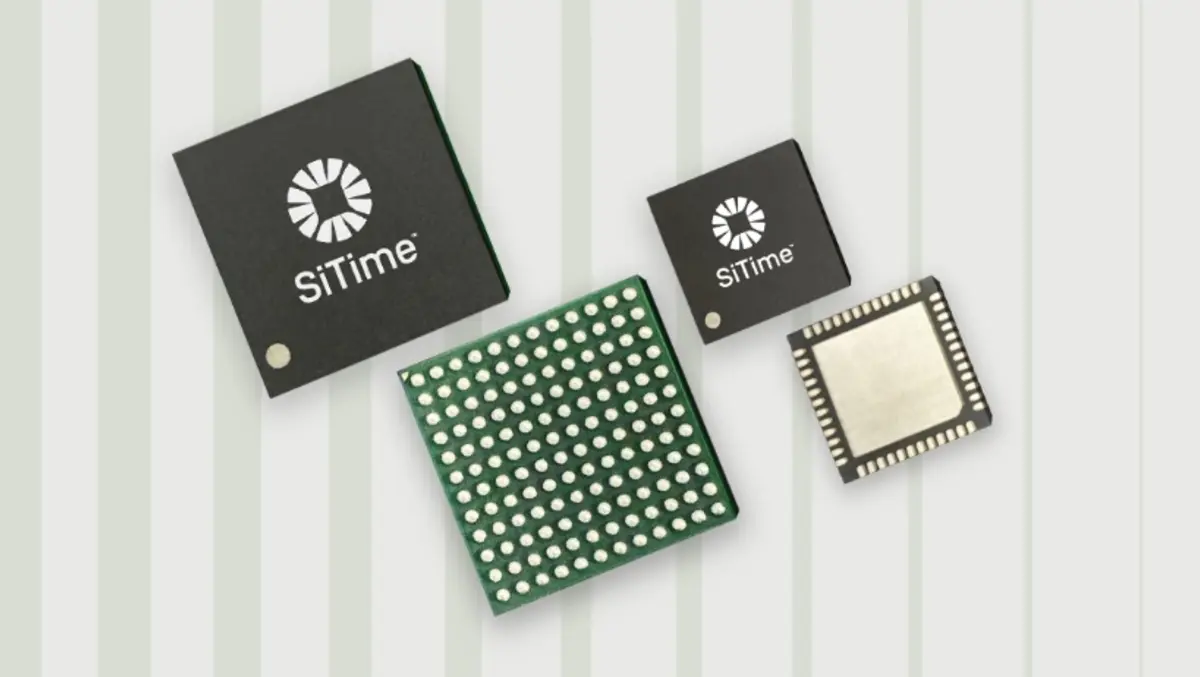
VersaClock 8 is a programmable clock generator for reference clocks used by CPUs, xPUs, memory and storage in PCIe 7 systems. The family comes in 5-output, 9-output and 12-output variants in QFN packages ranging from 4x4 mm to 6x6 mm. According to SiTime, the 12-output version is about 40% smaller than a comparable solution.
SiTime also highlighted power and thermal considerations in dense computing hardware. VersaClock 8 is designed to limit self-heating and operate at temperatures up to 105C, a specification aimed at compact compute trays in heavily populated racks.
Market focus
SiTime framed the launch around rising traffic demands in AI systems and network infrastructure. It said engineers already familiar with the FemtoClock and VersaClock lines may be able to reuse software and existing design knowledge when moving to the latest platform generations.
"Insatiable demand for AI, along with rising performance requirements, is driving the need for greater density and speed," said Piyush Sevalia, Executive Vice President and Chief Business Officer at SiTime.
"The FemtoClock and VersaClock families have a 20-year heritage and multiple generations of products. Over this period, they have led the industry in performance, density and shipments, and have become the default choice for many customer designs. Engineers know these architectures well. This familiarity enables them to design with confidence, get the most from these programmable clocks and reuse existing software. The result is higher-performance, denser AI hardware that generates revenue sooner. Built on this successful track record, FemtoClock 4 and VersaClock 8 extend SiTime's lead in Precision Timing," said Sevalia.
Bandwidth pressure
Industry analysts say timing components are becoming more important as system designers push towards faster interconnects across increasingly complex server and network architectures. The need to maintain signal quality at higher speeds has expanded the role of clock devices beyond a routine supporting function.
"The AI infrastructure build-out is exposing bottlenecks that go well beyond GPU compute performance," said Dave Altavilla, President and Principal Analyst at HotTech Vision and Analysis.
"Moving data efficiently across increasingly complex systems is becoming a critical design challenge, particularly as Ethernet and PCIe bandwidth requirements continue to climb. Precision Timing plays an important role here, especially as higher signaling speeds leave less margin for jitter and signal degradation. SiTime's latest clock families reflect how these underlying technologies are evolving to meet the precise needs of the next generation of AI data center architectures," said Altavilla.
SiTime said both FemtoClock 4 and VersaClock 8 are in production and available now.