

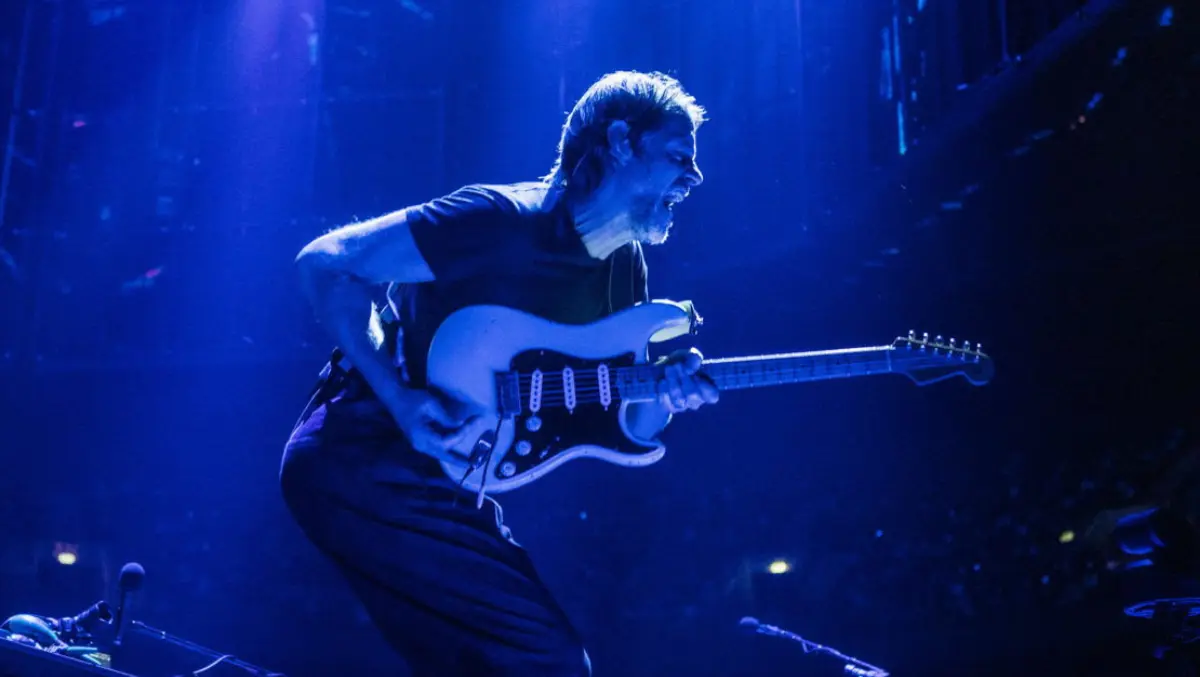
Radiohead adopts wireless guitars for European arena shows
Tue, 2nd Jun 2026.webp)
Radiohead used Sound Devices' Astral wireless system for guitars and microphones on its recent European arena shows, marking a shift from the band's long-standing reliance on cabled live setups.
The band's return to the stage after a seven-year break came with a redesigned production built around an in-the-round format. That increased the need for flexible movement and faster instrument changes, while preserving the sound standards the group and its crew have long prioritised.
Front of house mixer Simon Hodge said Radiohead had historically been reluctant to adopt wireless guitar systems because earlier options did not match the sound of a cable. Before the tour, the crew tested microphones and other equipment to determine whether a wireless approach could meet the band's requirements.
"The band is very invested in the experience being as real as possible without any 'fixes' or gimmicks," said Simon Hodge, Front of House Mixer, Radiohead.
"There's a lot of pressure for these shows to be amazing given the following that the band have. This is countered by the fact that the band are extremely reasonable people who are very invested in their output and their fans, so they enjoy the challenge to get the best results, rather than deferring to 'easier' solutions."
That preparation period gave the group and its suppliers time to assess whether newer wireless equipment had narrowed the gap with wired systems, including comparisons against the cables the band normally uses.
"We were lucky enough to have time in advance of the tour (and thanks to Brit Row and Sound Devices) to thoroughly audition mics and other kit to make sure that it was the very best it could be for the application."
Testing Process
Hodge said the technology had to improve before the band would consider changing its approach. Radiohead, he said, does not alter its live setup unless a new tool serves a musical purpose.
"The technology always needed to catch up in a sonic sense," said Hodge.
"The band doesn't tend to change how they operate for the sake of changing; they only are interested in upgrades that will serve their musical goals. Although the band have used RF systems for guitars in the past, the opinion was always that it never sounded as good as a cable and would not be adopted. In an arena, you have so many factors affecting the actual sound that go far beyond RF or cables, which is why we spend so much time in advance doing blind tests and ensuring we're starting from the best place"
He said the Astral system stood out because it allowed adjustments designed to mimic the electrical behaviour of a standard guitar cable and amplifier input. That gave the crew enough confidence to continue testing it with the band.
"When we became aware of Sound Devices Astral, we realized that the team had gone to some effort to make sure it truly did sound like a jack and cable input with customizable capacitance and impedance," said Hodge.
"I remember thinking 'We might finally have something interesting here.'"
According to the production team, Radiohead used three Astral ARX32 wireless receivers, 42 Astral TX digital wireless bodypack transmitters and six Astral HH wireless handheld microphones during the arena run. The transmitters were used across guitars and other sources because they could accept both microphone- and line-level inputs.
Stage Workflow
The wireless guitar setup also addressed a practical issue in Radiohead's live show: the sheer number of instrument swaps across a set. Hodge and Radiohead RF technician Matt Hayes built a custom arrangement linking the receivers into a Prodigy audio processor over Dante, with Stream Deck controllers used to manage access for players and guitar technicians.
That mattered because the band tours with a large number of guitars. Hodge said Ed O'Brien alone had 32 instruments available on the run.
"After listening to it myself, we brought it into Jonny [Greenwood]'s studio and did some blind tests between Astral and their preferred cables," said Hodge.
"We all listened and even the most cynical guitar techs were impressed! The quality of the audio path was obvious, and it wasn't changing the sound at all. The packs also auto-detect the cable, allowing us to easily adjust them in the receiver menu or UI as needed per instrument."
The operational benefit, he said, was that instruments could be switched more quickly without sacrificing access or control. That was especially relevant in an in-the-round production, where stage geography can complicate handovers and routing.
"The band travels with dozens of guitars, Ed O'Brien himself had 32 on this run," said Hodge.
"This was the first time we could have all 32 at once accessible and easily switchable in the same interface, a choice that either the musician or tech can make as needed."
He said the user interface helped the crew manage signal-flow changes during the show, reducing the time needed to handle transitions between songs and instruments.
"The need for quick, seamless changes in a live show is incredibly important and often more challenging when done in an 'in the round' setup as we had," said Hodge.
"The ease of use in the Astral UI allowed us to manipulate the signal flow seamlessly, which worked really well for the logistics of the show and allowed us total control with no compromises."
For Hodge, the result was a live setup that balanced intimacy with tighter technical control over sound and staging.
"It was an excellent experience for both the band and the fans because the setup allowed it to be intimate while still giving us excellent control of all the sonic and visual details that are so important," said Hodge.
"We are all very invested in that personal experience and anything added only makes the cut if it's guaranteed to do that."
"The Astral Guitar System ended up being a game changer for us, and the band have been quite happy with the results on stage."